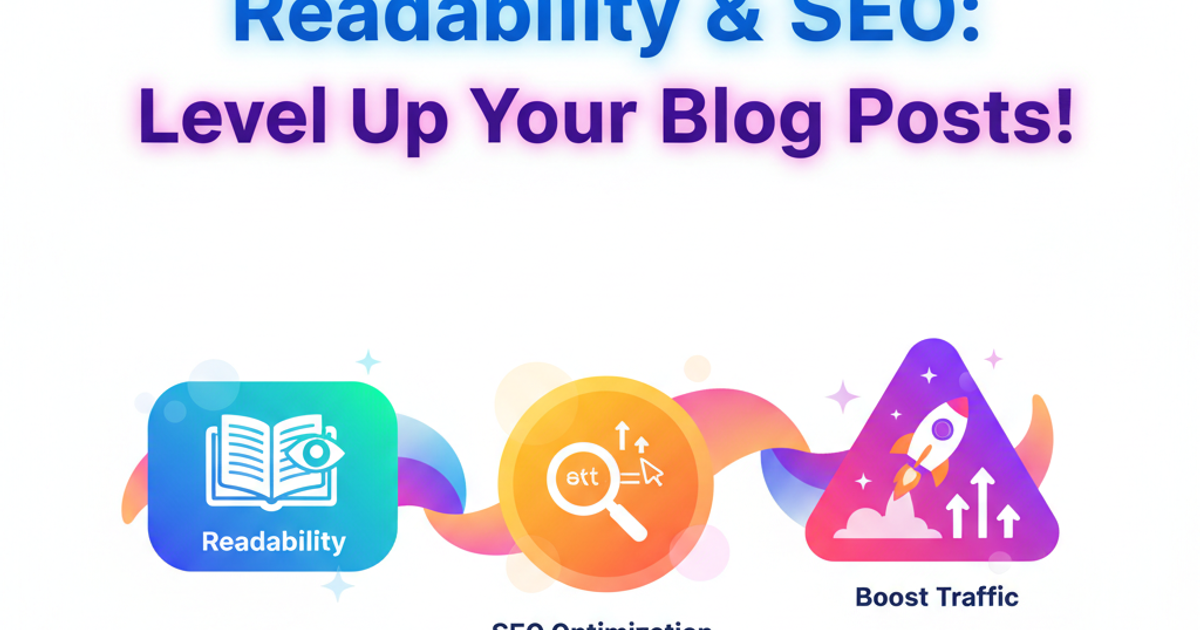
Readability & SEO: Level Up Your Blog Posts!
Ever hit publish on a blog post, feeling pretty proud of your meticulously researched content, only to see it languish in search results? You’ve optimized your keywords, maybe even crafted a killer meta description, but something’s still missing. Often, the secret sauce isn’t just about what you say, but how you say it. Today, we're diving deep into improving blog post readability SEO, a crucial element for keeping readers engaged and signaling to search engines that your content is top-notch.
Think about your own browsing habits. When you land on a page packed with dense paragraphs and a wall of text, what’s your first instinct? Mine is usually to scroll away or skim furiously, looking for the golden nuggets of information. Readers are busy, and they want information delivered clearly and efficiently. Search engines, especially Google, are getting smarter. They understand that a good user experience is paramount. If people bounce off your page quickly because it's hard to read, that’s a negative signal. That’s where focusing on readability comes into play, directly impacting your on-page SEO for blog articles.
Making Your Content Shine: Practical Readability Tips
So, how do we make our blog posts more digestible without sacrificing depth or accuracy? It’s all about strategic formatting and clear writing. Let’s break down some actionable techniques.
Short Paragraphs Are Your Friend
Remember those sprawling essays from school? Yeah, we don’t want that online. Long, unbroken blocks of text are intimidating. Aim for paragraphs that are just a few sentences long. This creates white space on the page, making it visually less daunting and easier to scan. Each paragraph should ideally focus on a single idea. This helps readers follow your train of thought without getting lost.
Embrace Subheadings (H2s, H3s, and Beyond)
Subheadings are like signposts for your readers. They break up the content, provide context for the sections that follow, and allow readers to quickly find the information they’re looking for. When we talk about improving blog post readability SEO, using descriptive and keyword-relevant subheadings is a game-changer. For example, instead of just “Tips,” you might use “Tips for Faster Content Creation” or “Key SEO Strategies for Bloggers.” This not only helps readers but also gives search engines more context about your content structure.
Bullet Points and Numbered Lists
Need to list out several steps, features, or benefits? Ditch the paragraph! Bullet points and numbered lists are fantastic for organizing information and making it scannable. They break up text and present information in a clear, concise way. I often use them when outlining steps in a tutorial or listing the pros and cons of a particular tool.
Bold and Italics: Use Sparingly!
Highlighting key terms or phrases using bold or italics can draw attention and emphasize important points. However, overuse can be distracting and make your content look cluttered. Think of it like adding seasoning to food – a little goes a long way. Use it strategically to reinforce crucial takeaways.
Crystal Clear Language
Avoid jargon, overly technical terms, or complex sentence structures where simpler alternatives exist. Imagine you're explaining a concept to a friend who isn't an expert in your field. Use active voice more than passive voice. Instead of “The report was written by the team,” try “The team wrote the report.” Active voice is generally more direct and engaging.
You Might Also Like
- Unlock Your Blog's Potential with Smart Internal Linkingin Content Marketing
- Blog to Social: Automate Your Content Sharing!in Content Marketing
- Kickstart Your Content: AI Writing Tools for Blog Introsin Content Marketing
Visual Appeal: Images, Videos, and Graphics
Walls of text can be tiring. Incorporating relevant images, infographics, videos, or even just well-placed screenshots can significantly boost engagement and break up the monotony. Not only do visuals make your post more appealing, but they also offer opportunities for further on-page SEO optimization. Alt text for images, for instance, is a simple yet effective SEO tactic.
The Power of a Strong Opening
Your introduction is your hook. You have mere seconds to convince readers to stick around. Start with a compelling question, a surprising statistic, or a relatable anecdote. Clearly state what the article is about and what the reader will gain from it. This initial engagement is critical for reducing bounce rates and improving user experience, which search engines notice.
The SEO Connection: Why Readability Matters for Rankings
It might seem counterintuitive – how can making text easier to read actually help you rank higher? It all boils down to user signals and the search engine's goal: to provide the best possible answer to a user's query.
When your content is highly readable, people are more likely to:
- Spend more time on the page (Dwell Time): If readers are engrossed and find your content valuable and easy to consume, they'll stay longer. Search engines interpret longer dwell times as a sign that your page is relevant and satisfying.
- Visit fewer pages and leave (Lower Bounce Rate): A low bounce rate indicates that visitors found what they were looking for and were engaged. High bounce rates suggest the opposite.
- Share your content: Easy-to-understand and valuable content is more likely to be shared on social media, which can drive traffic and generate backlinks – both positive SEO signals.
- Return to your site: A positive experience encourages users to bookmark your site or return for more content.
These user experience metrics are increasingly important factors in search engine algorithms. Google, in particular, emphasizes user-centric metrics. By focusing on improving blog post readability SEO, you’re not just making your content better for humans; you’re also sending positive signals to search engines that your page offers a great user experience and valuable information.
Keyword Integration: Balancing Act
While readability is key, don't forget your keywords! Naturally weave your primary and secondary keywords into your content. Use them in headings, subheadings, the introduction, and throughout the body text where they make sense. Tools like BlogMe can help you identify relevant keywords and analyze their placement. The goal is to make the content flow naturally, not stuff keywords unnaturally. A post that’s too focused on keywords and ignores readability will likely fail. It’s about finding that sweet spot.
Accessibility Considerations
Readability also touches on accessibility. Ensuring good contrast between text and background, using readable font sizes, and providing text alternatives for images all contribute to a better experience for all users, including those with disabilities. This inclusive approach is not only ethical but also aligns with broader web standards and can indirectly benefit your SEO.
AI's Role in Readability and SEO
Here at the BlogMe Blog, we're all about leveraging AI to enhance content creation. AI tools can be incredibly helpful in analyzing readability scores (like the Flesch-Kincaid score), suggesting simpler word choices, and even helping to structure your articles with appropriate headings. While AI can provide valuable insights and assistance, remember that the human touch is irreplaceable. You still need to bring your unique voice, perspective, and nuanced understanding to the content. Use AI as a co-pilot, not the pilot itself.
Ultimately, improving blog post readability SEO is an ongoing process. It requires a conscious effort to write clearly, structure content effectively, and always keep the reader at the forefront. By making these adjustments, you’ll not only create content that people love to read but also content that search engines love to rank. It’s a win-win that drives traffic, engagement, and ultimately, success for your blog.
BlogMe Team
Expert insights and analysis to keep you informed and ahead of the curve.